中文简体


| The big cheese | |||
http://english.dbw.cn
2011-12-13 11:18:10
|
|||
|
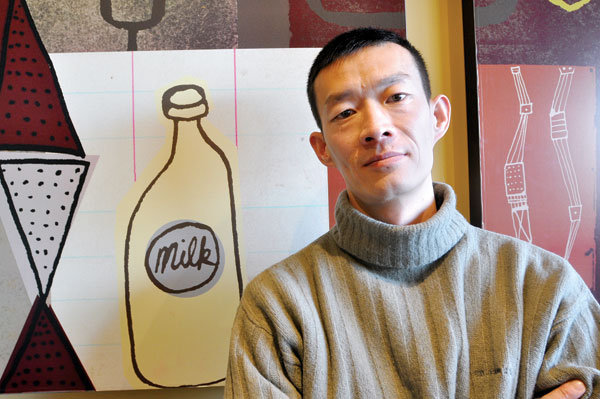
Finding fresh, French-style cheese in Beijing was a difficult mission until Liu Yan set up his grandly named business, Le Fromager de Pekin, which concentrates on making the soft, pungent-smelling varieties that are so popular in Europe. Until French-trained Liu came along, people who had a hankering for fresh fromage - mostly expatriates, or Chinese who have lived overseas - had to pay inflated supermarket or deli prices for a product that might have lingered on the shelves too long. The other option was to order the cheeseboard selection at a posh hotel restaurant - an expensive exercise. Liu began on a small scale, producing brie and camembert-style cheeses, initially at his home and, later, at a factory in the suburbs of the capital city. Reaction was favorable, so much so that Liu began experimenting with other varieties that also received approval from the city's cheese-loving gourmands. "When I first ask people what they thought, they said it was fantastic," he recalls. "I did a menu degustation in a restaurant and there were about 50 people from different countries and I tried them with the different cheeses. I started by making four cheeses and had plenty of time to experiment with different kinds; we now have 15 choices. "The most popular is the Beijing gris, which is similar to a camembert, I don't want to call it camembert, because it is not exactly the same, as the color and texture is different. Next, I will make a semi-hard cheese. I could easily double production if the demand is there but I don't want to grow too fast, the most important thing is to keep up the quality." Until Liu went to study business in the Auvergne region of France a decade ago, he had not sampled real, non-processed cheese, only the bland-tasting packaged variety sold in supermarkets throughout China. Like most people tasting cheese for the first time, the smell and taste took some getting used to. "The first proper cheese I tried was when the university had a party to welcome all the foreign students," says Liu. "There were 20 different kinds of cheeses served with French wine. It was very smelly, but I liked it a lot. "Looking back, it was not so strong but it seemed so at the time. Later when I was in Corsica I lived in the middle of a small village and my neighbor was a cheese-maker who had 400 sheep. He taught me how to make cheese and gave me the idea to start a business in China later. "I wanted to do something original, and thought cheese could be a good idea, so I went to a professional school to learn cheese making. The secret of it is good quality of milk and good factory conditions with good humidity: The best cheese is always made with raw milk, not pasteurized."
|
|||
| Author: Source: xinhua Editor: Yang Fan |
|||