中文简体


| Inflation turning point to come, but monetary tightening should continue: experts | |||
http://english.dbw.cn
2011-09-13 14:51:28
|
|||
|
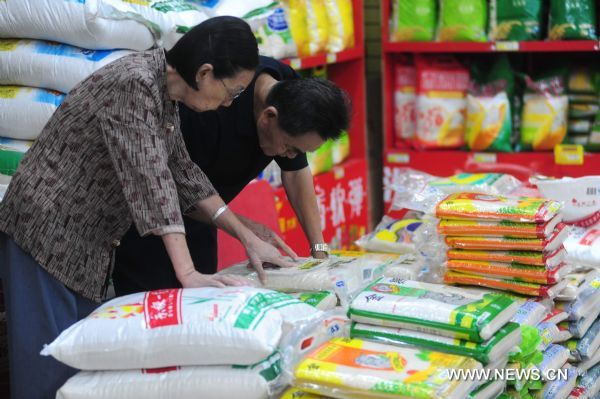
Consumers select rice at a supermarket in Qionghai City, south China's Hainan Province, Sept. 9, 2011. China's Consumer Price Index (CPI), a main gauge of inflation, eased to 6.2 percent in August, the National Bureau of Statistics (NBS) said on Friday. Food costs rose by 13.4 percent in August from a year ago. (Xinhua/Meng Zhongde) Inflation pressure remains high Though August CPI dropped slightly, China is still confronted with a mounting inflation pressure because of the ever-increasing production costs and surplus market liquidity. The low and middle-income groups are heavily burdened by the high food prices, the driving force behind the current price hikes. The National Development and Reform Commission (NDRC), the country's top economic planner, said on August 30 that the country's prices might continue to hover at high levels and many factors increased the difficulty in meeting this year's inflation control target. Imported inflationary pressures have not been visibly eased and global commodity prices are still high, the commission said in a statement on its website. Domestically, NDRC said there are still upward pressures on production costs, while natural disasters and media speculation could enhance the public's inflation expectation. Many analysts anticipate that China will face higher pressure of imported inflation, as the soft U.S. dollar, a result of the ultra-loose monetary policy in the United States, could further push up commodity prices. High inflation is expected to stay for some time to come, most probably between 4 percent and 5.4 percent in 2011 and 2012, a team of economists from the Xiamen University in China and the National University of Singapore said in their latest forecasts on the China's economy released on August 20, in Singapore. The view was echoed by Liu Ligang from ANZ Bank, who noted that as far as the food prices are concerned, it’s hard to say that the pork price will fall within the year. If not, then it will in turn likely drive up other food prices. Furthermore, as the result of high inflation pressure, production costs, such as fertilizer costs, will soar constantly, thus sending food prices to jump in the long run. “China’s inflation pressure will unlikely fall in the short term,” Liu stressed. Fan Jianping, chief economist of the State Information Center, told the Xinhua reporter that for the time being, the hidden currents of the global economy are fluctuating with imported inflation and structural price rises being the salient characteristics. “The prices of farm products may further increase and we should watch out for new price rise factors and transmission of international liquidity, which might affect next year’s carryover factor,” Fan added. |
|||
| Author: Source: xinhua Editor: Yang Fan |
|||