中文简体


| Halal Cuisine | |
http://english.dbw.cn
2011-09-08 15:16:45
|
|
|
The ethnic group of Hui concerns about hygiene very much. They always pay special attention to sanitation of food in addition to personal hygiene and family health. Hygiene and sanitation are of great significance and noticeable everywhere. Hui group only has halal food. It includes some halal cuisine and foods such as cakes, moon cakes, biscuits, sesame cookies, stuffed bread, halal beef, mutton, chicken, rabbit meat and fish cans, jerky, bean products, dairy products, candies and wheaten food. Traditional wheaten foods, for example, includes deep fried cake, dough twist, hard cake, sweet cookies, and multi-layer steamed bread and are normally made by frying, baking, toasting, and steaming. The foods taste very good and crispy with either salty or sweet flavors and have attractive bright colors. According to incomplete statistics, there are over 200 types of halal food in Ningxia. At present there are three major cuisines worldwide: the Eastern cuisine, the Western cuisine, and the Islamic cuisine. The cuisine of the Hui group has absorbed the merits of both the Eastern and the Islamic cuisines. For halal purpose, Chinese Hui attaches particular attention to quality and sanitation, and adopts a tightened approach for selecting raw materials. The animals must be slaughtered when it is alive. Wheaten food is mostly fried. For rich and well-combined nutrition and unique features, the Hui cuisine is popular all over China and deserves to be great out of all Chinese foods. Hui’s banquet is consisted of four to eight dry fruits dishes first, and then eight or ten or thirteen or fifteen hot dishes with different names, for instance “Full Moon on the Fifteenth Day of the Lunar Calendar”. Hui’s banquet serves meat most and emphasizes efficiency on table. There are two ways to have Hui’s banquet. The first one is to have the dished enjoyed and served in the same time and dishes will be collected when guests finish. The second one is to have one dish enjoyed and finished before the second one. When all guest finish, the dishes will be collected. Covered Bowl Tea
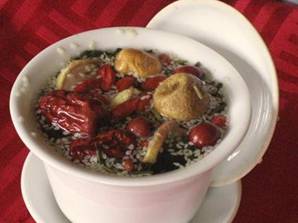
Covered bowl tea is a traditional drink of the Hui group. Since the tea set consists of a tray, a trumpet-shaped bowl and a cover, the drink is called covered bowl tea or three forts. According to legend, this tradition dates back to the Zhenguan years during the Tang Dynasty. The tea is named after different ingredients, such as brick tea with brown sugar, light tea with white sugar, litters tea with crystal sugar, tea with three sweeties (tea leaf, crystal sugar and longan), spiced tea (crystal sugar, tea leaf, longan, raisin and dried apricot), and assorted tea (red date, wolfberry, walnut meat, longan, sesame, raisin, white sugar, tea leaf). The Hui group pays particular attention to infusing. They believe snow water and spring water are the best. When the tea is served to the guest, the host must open the cover first, water the bowl with hot water, put in sugar, tea and other raw materials and then fill in boiled water. Then the host shall hold the tea to the guest with both hands. This is to show respect to the guest and the tea is not left over by others. The tea is not only served to guests but also drunk by the host himself to maintain health. In general different types of tea are prepared according to seasons and people’s physical condition. In summer jasmine tea and green tea are most popular; while in winter Shan oolong tea is better. Brick tea with brown sugar is drunk to drive away coldness and soothe the stomach; light tea with white sugar is good for digestion; to clear away heat, litters tea with crystal sugar is very effective; assorted tea helps to refresh, improve eyesight, strengthen health, promote digestion, and prolong life. When drinking the covered bowl tea, one needs to lift the bowl with the tray and stir the tea with the cover to make it richer. Then the cover should be put on the bowl with an inclination. Next the tea can be sipped. One should not lift the cover to blow the tea leaf floating on the water nor gulp it down. Instead it should be slowly drunk. If one wants a refilling, he should leave some water in the bowl. Deep Fried Cake
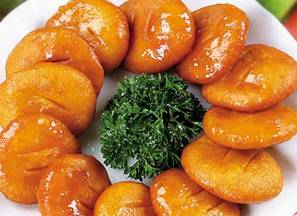
The deep fried cake is a special food for holidays, weddings, and funerals. The food is made by mixing boiled water and flour and adding some salt. Then the mixture is shaped into cakes and fried with oil. The food culture of the Hui group is similar to that of Han, except that the religious doctrine bans the eating of pig, horse, donkey, and mule meat. Boiled Lamb
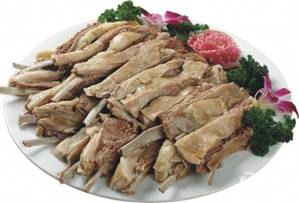
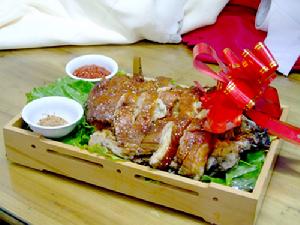
The boiled lamb is a traditional local food of Ningxia. It is cooked from the castrated Tan sheep, the meat of which is lean and tender and can be digested easily. Furthermore, it is free of the usual mutton odor and rich in protein. The boiled lamb looks, smells and tastes good and is not greasy. Preparation of the boiled lamb is by cutting mutton into chunks weighing about 1 kg, putting the chunks into boiled water, adding seasonings such as pepper, fennel, star anise, Chinese cinnamon, apricot and orange peel, and boiling the meat until it can be separated from the bones by shaking. Other seasonings such as the sesame butter, soy cheese (made into juice), bloated leek, soy sauce, chopped green onion, mashed garlic, and chili oil should be prepared and mixed in little bowls according to personal preference and eaten along with the meat.
Stewed Sheep Entrails
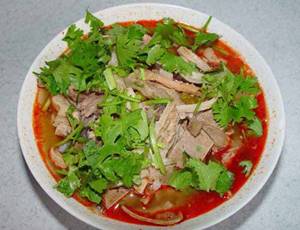
The stewed sheep entrails has a unique flavor. It is made from entrails, head meat and hoofs of the sheep, which are washed, boiled and shredded. The dish is completed by adding the shreds, green onion, ginger, mashed garlic, red chili oil, gourmet powder, and caraway in the original soup. In the dish the red is the chili oil, the green is the grated green onion and caraway, while beneath is the milky soup. Altogether the dish is neither cowy nor greasy, but savory and mellow. The favorite wheaten food of the Hui group in Ningxia is the pulled noodle with mutton. Other wheaten foods are also very special: for example, with their golden color, the deep fried cake and the dough twist are crisp and delicious. Other local delicacies, such as the hand-pulled noodles with beef and dumplings with soup and bean jelly, are all hand made from carefully selected raw materials. Stone Roast Lamb
In the Chinese cooking history, stone cooking is the most ancient among the fire cooking methods. The stone cooking first appeared in the Stone Age and before the invention of pottery. During that time, people made simple production tools and life utensils with stone. Stone baking of grain ---- the primitive cooking method was also invented then. It is said in the Checking of the Ancient History, when Shennong, the patron of agriculture, was alive, people ate grain by cooking it on hot stone. According to relevant historical materials, there are two kinds of stone cooking: one is to cook food by water boiled with burnt stone; the other is to put food directly on burnt stone. The Western Xia stone roast lamb is cooked with the second method, in which the heat is evenly transmitted by the stone. This method dates back to five thousand years ago but is still in use nowadays. The food prepared in this way is a great attraction to those who traveled to the northwest of China. |
|
| Author: Source: xinhua Editor: Yang Fan |
|