中文简体


| Beautiful backwaters | |||
http://english.dbw.cn
2011-08-12 11:32:16
|
|||
|
Above the clouds In addition to some fantastic sight seeing, you won't escape a visit to Lishui without some incredible dining. The evening we visited the caves, we ate in a restaurant serving typical Zhejiang cuisine, including dongpo rou (pork belly stewed in soy sauce and wine), xihu cuyu (West Lake fish in vinegar) and the delicious jiaohua ji (misleadingly known as "beggar's chicken"). In fact, the only complaint with the food in this part of China is that it is almost as lip-smackingly salty as it is in neighboring Ningbo. The meal was naturally accompanied by one of the area's most successful exports, Shaoxing yellow rice wine, a far richer and more flavorsome drink than the poor imitations brewed in Shanghai. Unfortunately, the highly unpredictable, and often inclement, weather prevented us from enjoying the full camp fire meal we had originally planned, but the restaurant owner did allow us to build a makeshift fire in the courtyard after dinner, allowing us to mingle and socialize into the wee small hours. The next day, after a hearty breakfast, we set out early for the Nanjianyan scenic spot in Suichang county, otherwise known as the "village that lives above the clouds". Besides its natural beauty, this area is best known as the birthplace of Tang Xianzu, who authored The Peony Pavilion during the Ming Dynasty (1368-1644) and is widely regarded as the Shakespeare of the Orient. It is easy to see how the surroundings may have inspired his artistry: An enchanting landscape of tea terraces, bamboo forests, pine groves and winding mountain streams and waterfalls are sure to entrance any visitor. One of the more fascinating features of this eclectic topography is a vertical tower of pure granite rock that rises up from the earth like an ancient, man-made obelisk. At the uppermost peak of the area (an elevation of 1,610 meters) we ventured onto a glass-floored viewing platform. Sadly, the early morning mist obscured our view and most of us prepared to leave without getting any pictures of this miraculous panorama. But within minutes the fog had lifted, revealing the surrounding hills – as well as the view to the valley below – in all their breathtaking splendor. The entrance to the site is 50 yuan and you should set aside about an hour and a half for a complete guided tour of the area. That afternoon, we headed off to the Tangmuyuan Hotspring Resort, about 25 kilometers from Suichang county. Against a backdrop of tea fields, this expansive resort can proudly claim to be one of the first of its kind to be built in Asia. It boasts more than 50 hot spring pools, each offering different functions, temperatures and attractions, including a fish pool, a Chinese medicine pool and an air-bubble massage pool, all enlivened by the invigorating fresh air of the surrounding forests. The entrance ticket per person is 98 yuan.
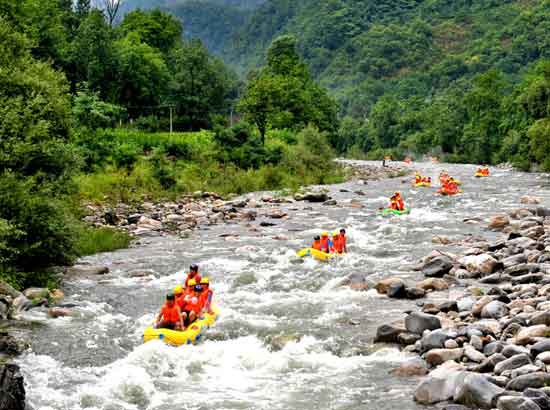
River warriors On the last day of the trip, we set out for something really adventurous: white water rafting on the Wuxi River. Perhaps I should point out that this is not as dangerous as it first sounds, and that as far as fast flowing rivers go, this is definitely a child-friendly version that is suitable for the entire family. The river takes its name from the term meaning "black river" (as opposed to the famous city in Jiangsu Province), although in fact the water is more of a jade-green color. Life jackets and boats can be rented at the beginning of the rafting route for 98 yuan, and if the weather is particularly bad, you can also purchase waterproof kagools for another 10 yuan. The river bed was wide enough to carry our 10 boats in unison (with three in each boat) and the organizers place a trained guide and rower in each vessel. Our group fortunately only suffered one capsizement, although it should be pointed out the water is less than six feet deep. The river is surrounded by partially-quarried hills and the odd hill side cottage, although the locals who watched us careering down the rapids with wide-eyed bemusement looked as though this would be the last thing they would consider doing in, or on, the river. In all, the rafting adventure takes about one hour and covers 3.5 kilometers. Staff from the rafting center are positioned at either end of the route to offer assistance – and hot tea – to their guests. Be warned however, that you will get wet from the waves and that rafting is only advised when the weather is, at the very least, mild and temperate. <<previous [1] [2]
|
|||
| Author: Source: Global Times Editor: Wu Qiong |
|||