中文简体


| Land of eternal blue sky | |||
http://english.dbw.cn
2011-07-19 10:16:25
|
|||
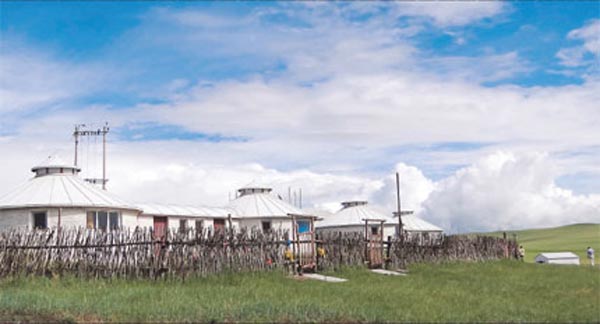
We have a small forest, the Greater Hinggan Range, which extends 1,220 kilometers from north to south in Inner Mongolia Autonomous Region and Heilongjiang Province. We have a small river, the Argun River, which extends 1,620 kilometers and divides China and Russia. We have a small cadre, Genghis Khan, who established the Mongol Empire, the largest contiguous empire in history. These sweeping understatements are used by locals of Hulunbuir City to introduce to us their hometown, humbly and proudly, when we arrived at Hailar District, the administrative center of the vast grassland. The city, in northeastern Inner Mongolia, is larger than most Chinese provinces and is recognized as the largest city in the world in terms of area. Since it's so large, it often takes two or three hours to drive from one tourist destination to another. The region is best known as the Hulunbuir Grassland, one of the most beautiful grasslands in the world where many nomadic groups, including China's Mongols, originated. This is also where ancestors of Genghis Khan established their tribe and where the great emperor fought for many years and was said to be buried. Mysteries swirl around Genghis Khan, who conquered most of Eurasia in the 13th century. He is now considered a hero who united the ethnic tribes in the area; one of the biggest mysteries is the location of his burial site. It's supposed to be somewhere in the grassland. Legend has it that after he was buried Mongols used dozens of horses to trample and flatten the ground, and it was guarded by hundreds of soldiers until the grasses at the site grew back and were identical to all the other grass. It became invisible. |
|||
| Author: Source: xinhua Editor: Yang Fan |
|||