中文简体


| Then and now, a foreign 'Babe's' look at Beijing | |||
http://english.dbw.cn
2011-06-30 15:24:23
|
|||
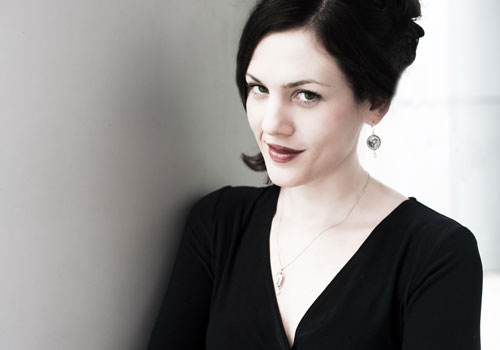
Like many other foreigners who come to Beijing, Rachel DeWoskin fell in love with the city. But unlike her compatriots, she learned the facets of Beijing life while starring in a Chinese soap opera. DeWoskin gained notoriety playing the character of Jiexi, an American temptress on "Foreign Babes in Beijing," a drama about interactions and relationships between foreigners and locals. In her memoir of the same name, DeWoskin narrates her life with wit and illumination as she straddles the American view of China and the Chinese view of foreigners. DeWoskin moved to Beijing after graduating from Columbia University and stayed from 1994 to 1998. However, China was not new territory; she grew up with a Sinologist father who spent summers pursuing various studies in the country. "I spent my childhood summers excavating ancient instruments in rural villages and following my parents around like a puppy. It was both challenging and exhilarating," she explains about her youth. "China was always a part of my house, always a part of my family, always a part of my imagination." Her childhood adventures still did not prepare her for life as a young adult in Beijing; she arrived at age 21 with plenty of misconceptions about blending into local life. "I had this idea that if I just learned enough Chinese, I would be totally fluent in Chinese literature, and I'd understand my Chinese friends and their imaginations and their views of the world, and it would be easy for me, which wasn't true at all," she says of her early days living here. "I never learned Chinese fluently enough, I always had a slippery grip on it. And it wasn't just the language, there's a million things that were different. But I liked the adjustment and the disjunct of living in a place where things are not obvious or easy or familiar to me." However, she firmly refrains from nostalgic sentiments. "I don't pine for the way China was then. First off, I think it's patronizing," DeWoskin explains. "Chinese people like Frappuccino, so why shouldn't there be Starbucks in China? You're not allowed to sit at a Starbucks in New York and long for the hutongs to remain here instead of modern living." Beijing's original "foreign babe" has seen Beijing mature into a global, cosmopolitan city over the last two decades, a far cry from the Beijing she knew where foreigners could hardly find a legal place to live and the streets were rivers of bicycles. "You couldn't get a salad in 1994," she says. Today's Beijing is unrecognizable from the one she knew in the mid-1990s. While Beijing's new, stunning architecture is the most obvious change gripping veteran visitors, DeWoskin sharply observes that much of the change has been in the people. "The camaraderie and familiarity between the expatriates and the Chinese is so much deeper and broader and bigger than it was when I lived here, and I'm thrilled because I feel we've moved in the right direction," she notes. She offers a caveat about Beijing's development, that the city's historical and cultural treasures should be preserved and remembered, but says these changes have been positive overall. "Globalization has real costs, so I don't want to be an uncritical cheerleader for globalization or modernization," she asserts. "But I think that most Beijingers, if you ask them, will say their lives have improved and modernization has benefited them." Many of her old hangouts have been razed in the new development of Sanlitun, but one of her favorite spots for years has been the Tuanjiehu water park, which she says is a fascinating study in local culture. Modern development of some old landmarks has also surprised her, such as the Beiying film studio where she filmed "Foreign Babes in Beijing," which she revisited last summer, "The Beiying film studio now is like Hollywood, it's so hi-tech, so first-world. When we did 'Foreign Babes,' we had latrines; we didn't have running water." DeWoskin is outspoken about her love for urban environments, and a big fan of New York City, but she does note that Beijing's environment has a special feeling that she misses in the United States. "I miss the constant feeling of being a part of something that's happening. There's a very present-tense feeling in China," she notes. "The U.S. has more of a settled atmosphere, even in New York City. I like the interaction, the conversations that happen in Beijing, both about Beijing and the world." That sense of cultural interaction is something she hopes to pass down to her young daughters; like her own childhood spent hunting for ancient tools in rural China, she has insisted on bringing her two girls on all her international trips. "For them, the world is big and full of differences, which is important to me," DeWoskin explains. "I don't want my kids to grow up in a homogenous place; I want them to jet about the world." Rachel DeWoskin is a professor of poetry at the University of Chicago, but she returns to Beijing more than once a year, usually spending the summer here. She is back in China to promote her new book, Big Girl Small, which is about a little person faced with scandal at her high school. This summer, she starts her 3-month stay in Shanghai under the M Literary Residency program and she's working to adapt her memoir, Foreign Babes in Beijing, as a television show for HBO, an American cable channel. DeWoskin will be leading a book talk about her latest work, Big Girl Small, at The Bookworm in Beijing on June 28. Catch her in Shanghai at M on the Bund on July 8. |
|||
| Author: Angela Pruszenski Source: CRI Editor: Wu Qiong |
|||