 中文简体


| Shijinhuayuan Hutong: Preserved by powerful connections | |
http://english.dbw.cn
2011-06-15 18:14:01
|
|
|
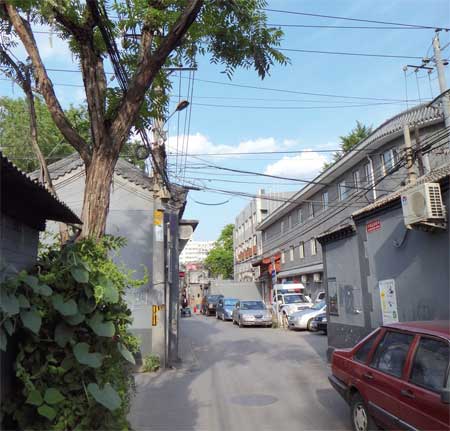
Typically, hutong are lanes formed by rows of siheyuan courtyard houses arranged one after the other on either side of the path. But as more and more hutong are gradually changing in style, it is getting harder and harder to identify one from its current appearance. Walking on the Dongsibei Dajie, you may come across Shijinhuayuan Hutong, a lane that looks at first glance like a dead end from the east side. The access is assembled with high modern buildings that challenge its hutong identity. This small lane winds in the shape of letter "Z," and you really have to walk halfway through to get to the real flavor of hutong. Yet that is not how it was back in the old days, when it was an assembly of elegant private gardens. Shijinhuayuan Hutong housed many celebrities, including famous opera performer Chen Yanqiu in No. 6, the calligraphist and Sinologist Qi Gong in No. 21, and Dai Li, the right-hand man of Chiang Kai-shek, in No. 19. The four-courtyard siheyuan at No. 23 extends all the way from Shijinhuayuan Hutong to the Weijia Hutong on its north; renowned warlord Wu Peifu (1873-1939) lived in the back yard of that place, leaving the front yards as the working place for his assistants. Shijinhuayuan Hutong was known as a lane of celebrities, and if you ask the older people in the area, they'd tell you that the luxurious No. 19 was the inhabitance of Ma Huitang, who was famous as the man in charge of the construction of such royal architectures as those in the Summer Palace. Understandably, No. 19 benefited from his expertise and is one of the most magnificent siheyuan around, and big courtyards always draw high officials close. A 70-year-old woman surnamed Li, who said she lived in this hutong for three decades, said No. 19 was most recently the residence of Zhang Bangying, the former deputy minister of the Ministry of Civil Affairs. After he died last year, the residence was passed on to his heirs, who occupy it now. Not far from No. 19 is No. 23, the home of warlord Wu who moved in during the 1920s and lived there until he died. Now No. 23 has recently been renovated and occupied as a workplace by several government organizations. Under the ownership of these powerful people, the courtyards have been well-preserved. According to Li, this land is a favorite among filmmakers who were impressed by the luxury siheyuan. "One renowned film taken place here was Rickshaw Boy by Lao She," she said. "I remember that when they shot the film the whole lane was nearly blocked by passers-by." But while Shijinhuayuan Hutong remains in good repair, it attracts fewer visitors and tourists than other areas, as its gardens and siheyuan are closed to outside visitors. "People could pass through here many times and still not know what's inside these courtyards," Li said. "The lane is like a skeleton in the cupboard that always keeps its little secret." |
|
| Author: Source: China.org.cn Editor: Wu Qiong |
|


