 中文简体


| Faster than a speeding bullet train | |
http://english.dbw.cn
2011-06-15 18:14:46
|
|
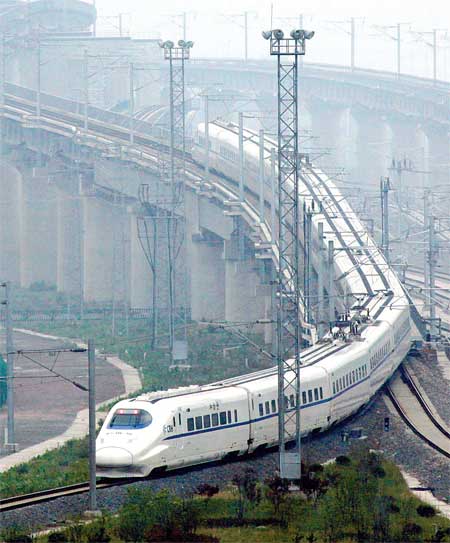 The new Beijing-Shanghai high-speed train that will open at the end of this month slices the 1,318-kilometer distance between our city and Shanghai down to a manageable five hours, opening up a whole world of weekend trips without the need to spend hours queuing in airport security. Racing along at a speed of about 350 kilometers per hour, the train runs through the municipalities of Beijing, Tianjin and Shanghai and the provinces of Hebei, Shandong, Anhui and Jiangsu, meaning there are plenty of places to stop off and see the sights. One-way fares to Shanghai cost 600 yuan ($92), so pick one up at the station and be sure to schedule plenty of stops to see all the best sights China has to offer along the way. Qufu East StationThe first station on the way is Qufu in Shandong Province. As the birthplace of Confucius and Confucianism, this stop is a cornucopia of cultural heritage - there are approximately 600 different historical sites here, so you could clearly spend the entire weekend just in this place, but the most famous spots are the Confucius House (Kong Fu), the Confucius Temple (Kong Miao), and the Confucius Forest (Kong Lin). Built during the Song Dynasty (960-1279) to house the descendants of Confucius, the Confucius House covers around 40 acres with approximately 480 different rooms, and expansion and renovation continue even today. The mansion is an enormous compound, with offices, pavilions, halls and residential quarters, and lush gardens in the back, and the classical furnishings and cultural relics, some given by emperors, make this mansion a must-visit as long as you're in the area. (Tickets are 60 yuan, or 150 for entrance to all three Confucian sites). The Confucius Temple, located by the south gate of Qufu, was originally built in 478 BC and is considered one of the first temples for paying tribute to Confucius. Built at the scale of a royal palace, the Confucius Temple is one of the three biggest ancient architectural sites in China (the other two are the Summer Palace and the Mountain Resort in Chengdu). Wrap up the Confucius tour at the Confucius Forest, which is actually a graveyard for the descendants of Confucius. It holds 100,000 graves, making it the largest, as well as oldest and best-preserved, family graveyard. |
|
| Author: Source: China.org.cn Editor: Wu Qiong |
|


