 中文简体


| Vegetable price slump hurts Chinese farmers | |||
http://english.dbw.cn
2011-04-26 14:52:26
|
|||
|
The current vegetable price slump may offer temporary support in China's fight against soaring inflation, but it has also taken its toll on Chinese farmers. China's ministries of commerce and agriculture have moved to stabilize the vegetable market after plunging prices reportedly forced a farmer in east China's Shandong Province to commit suicide and left many others with losses in other areas. Price drops for vegetables have occurred in many areas of China recently, including the national capital of Beijing, as well as Shaanxi, Zhejiang, Fujian and Henan provinces. This development has surprised many farmers, including Yan Baofu from eastern China's Shandong Province. "Everything I grew this year ended up with a sheer loss. Prices of tomatoes, cucumbers and peppers keep going down, not to mention celery and green onions. They're better off rotting on the farm," Yan says. According to data from the Ministry of Commerce (MOC), the average prices for 18 types of vegetables plunged 9.8 percent between April 11-17 than the previous week. In addition, average prices for 19 types of vegetables in 286 wholesale markets across the country fell 11.4 percent last week, according to the Ministry of Agriculture (MOA). "When my wife and I reaped cabbage in the field, we heard that the wholesale price was 0.3 yuan (about five U.S. cent) per kilo. But when we carried them to the market, the price had already decreased by nearly one cent," says Han Liji, a farmer at a vegetable wholesale market in Tangwang, a township 35 kilometers from Shandong Province's capital city of Jinan. Ten days ago, a 39-year-old farmer named Han Jin killed himself in Tangwang after he found himself in debt following the price decrease for cabbage. Vegetables prices often fall because of external factors, such as seasonal changes and increased supplies from the post-Labor Day holiday period. However, analysts say this year's price decrease came earlier than usual. Guo Hongwei, an official in charge of market operations at the Shandong Provincial Department of Commerce, says the key to dealing with sharp price fluctuations is to encourage farmers to sell their produce in a more collective way. "For vegetable farming, the risks of sharp price fluctuations will be increased if producers sell their vegetables separately," Guo said. Hoarding of produce by wholesale dealers and speculative investors excessively boosted vegetable prices last winter, causing farmers to expand their sown area for vegetables on a much larger scale this year, according to market insiders. Many of the vegetable types that have seen price plunges are the same as those targeted by speculators last year. Another Shandong farmer, who wished to be identified as Lu, said the price of cabbage has jumped several times in the township of Tangwang. These price increases came after many local farmers had started hoarding cabbages, expecting good returns on their produce. However, larger harvests than usual caused prices of cabbages to plummet, leaving many hoarders with large losses, Lu said. In north China's Inner Mongolia Autonomous Region, farmers of Wuchuan County have seen a similar phenomenon. Locals there started hoarding potatoes after prices rose to 1 yuan per kilogram. To date, about 100 million kilograms of potatoes in Wuchuan have yet to be sold, equivalent to roughly 35 to 40 percent of the country's annual potato output. The MOC has moved to support a mechanism that will guarantee insurance for farmers affected by price fluctuations. The new mechanism will also increase sales and facilitate stronger, more stable relationships between farmers and the supermarkets where the farmers sell their produce. The MOA has also called on local governments to take measures to help farmers find new markets and stabilize vegetable production. |
|||
| Author: Source: xinhua Editor: Yang Fan |
|||


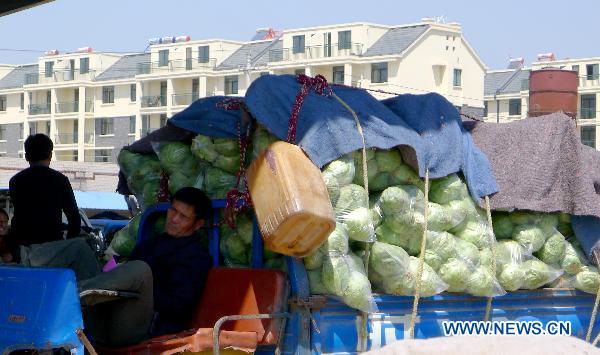


| Vegetable planters in E China suffer heavy economic losses | |
| East China province moves to ease vegetable oversupply | |
| Robots for vegetable planting works at 12th China Int'l Vegetable Sci-tech Fair in Jinan, China's Shandong | |
| Heilongjiang Province exported 51 thousand tons of vegetables in the first two months of this year |


