中文简体


| Managers bring new skills to gov’t | |||
http://english.dbw.cn
2011-04-07 15:05:05
|
|||
|
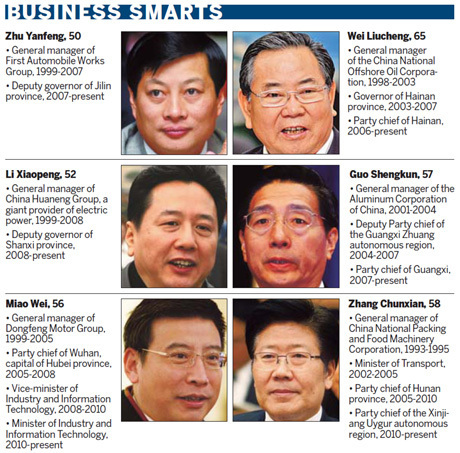
The relatively youthful group of former State-owned company executives who have joined the ranks of the nation's political elite got its latest member this weekend. Su Shulin, 49, left his million-yuan salary behind him as general manager of Sinopec Group, Asia's largest oil-refining and petrochemical enterprise, when he transferred to the post of deputy Party chief of Fujian province. According to official sources, Su began as a standing member of the Fujian provincial committee of the Communist Party of China and as deputy Party secretary of the province on Saturday. "(He) is familiar with corporate governance and management jobs in the modern era ... is a strong innovator and demonstrates keen leadership and organizational skills," said senior official Pan Ligang from the Party's top organizational authority. The prosperous eastern Fujian province spearheaded China's reform and opening-up policies and overlooks Taiwan across the Straits. And it is not rare for the three major State-owned oil corporations, which fuel the majority of the country's energy consumption, to cradle top officials. Zhou Yongkang, secretary of the Party's Central Political and Legislative Affairs Committee, was once general manager of the China National Petroleum Corporation. And Li Yizhong, former head of the Ministry of Industry and Information Technology, was formerly general manager of Sinopec. Governance experts told China Daily that, with the Organizational Department of the Party's Central Committee encouraging exchanges of leaders between business and the government, more corporate leaders, not necessarily only those from the oil sector, will move into politics and vice-versa. According to media reports, the list of such cases has grown long in recent years - mainly involving prominent business figures with strong academic backgrounds and sound management experience. Among them, 52-year-old Li Xiaopeng transferred from his role as general manager of China Huaneng Group, a giant supplier of electric power, in June 2008 to become deputy governor of coal-rich Shanxi province. Ai Baojun, 51, vice-mayor of Shanghai, was once general manager and chairman of the board of Shanghai Baosteel Group Corporation, the world's second-largest steel producer. And Zhu Yanfeng, 50, general manager of First Automobile Works Group until December 2007, was later elected deputy governor of Jilin province, where the corporation is based. Like Su, those business-figures who became senior officials tended to transfer first as Party leaders of regions and were then elected by local people's congresses to become governors or were given roles by the State Council. Experts said the senior managers, who are proficient in economic affairs, are likely to boost the ranks of government officials, who are largely drawn from political backgrounds or from the ranks of technocrats. "They are very familiar with the market economy," said Guo Weiqing, a professor of political science at the Guangzhou-based Sun Yat-sen University, in an interview with Beijing News. "In addition, senior mangers of State-owned companies usually have international vision and modern management ideas." Professor Li Xuefeng from the Chinese Academy of Governance, said business smarts and experience will improve public administration in many ways, including the provision of services, cost control and efficiency. "It's also a trial that pumps new blood and ideas in to facilitate reform of State administration. "Many Western countries, such as France, have similar exchanges," he added. |
|||
| Author: Source: xinhua Editor: Yang Fan |
|||