中文简体


| Little Shop of Curiosities | |
http://english.dbw.cn
2011-03-24 11:11:36
|
|
|
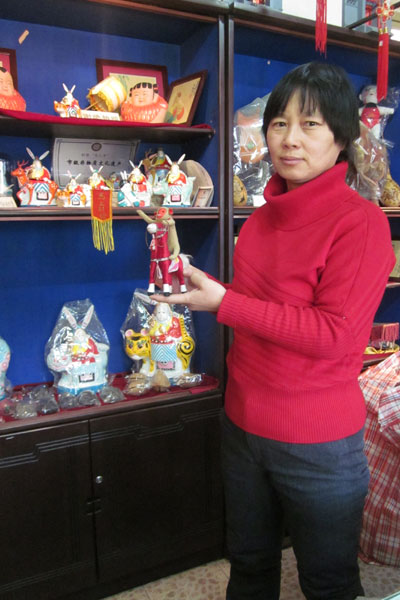
Shop owner Ms. Tang poses with her creations at Bannerman Tang's Toys and Crafts. [Photo:CRIENGLISH.com]
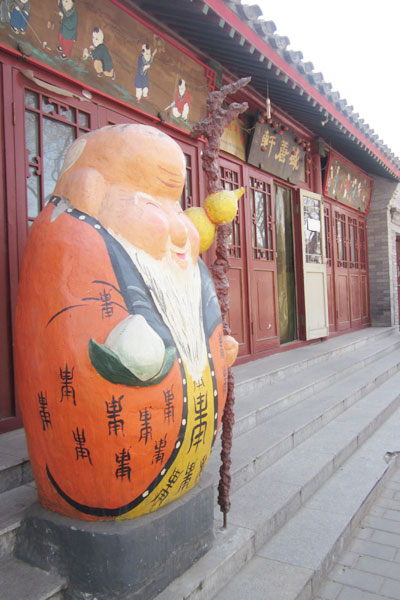
Giant toy statues greet visitors at the entrance to Bannerman Tang's Toys and Crafts. [Photo:CRIENGLISH.com] By Angela Pruszenski "Play is the most important thing," Ms. Tang, fifth generation toy-maker and owner of Bannerman Tang's Toys and Crafts, said. "Making toys is more of a hobby instead of work, which is why we've been able to preserve our craftsmanship so well." Tang's enjoyment of her work is evident in the fascinating trinkets that fill her small shop to the brim. The one-room shop, just down the street from the Confucius Temple, is lined with shelves crammed with intricate figurines, all hand-made by Tang and her family. Brightly-colored ornaments hang from the ceiling, and a large display case in the center of the room is scattered with old toys, making it difficult for the eye to focus on just one item. The toys sold here are better for keepsakes than for child's play. Meticulously-painted clay statues in glass cases depict colorful figures such as traditional newlyweds or Peking Opera stars that occupy the shelves near the entrance, ranging in price from fifty to several hundred yuan. Festive-looking traditional lions take up several shelves elsewhere in the shop, while clay-painted zodiac animals are aplenty (and start at 20 yuan for a pair of mice). Other creations depict scenes from everyday life in old Beijing. Some of the shop's offerings are clearly new creations, such as the series of child statues in amusing poses, but traditions still hold a special place here. According to tradition, on the second day of the first lunar month, people would go to the temple to pray for wealth. Afterwards, a golden horse would be "invited," not "bought" to be placed in the family kitchen, in the hopes of making money, immediately. The Chinese word for "horse" (ma) is also part of the term for "immediately" (mashang). After one year, the horse would be returned to the temple. Now, she says her family is the only one still making them in Beijing. Tang's family began making toys as a hobby during the late Qing dynasty. Their creations gained popularity as they were given to relatives and friends as gifts. "As time went on, my family's skills improved and became more professional and unique," Tang explained. The hobby eventually turned into a steady income stream for the family. Five generations later, Tang says she's worried that traditional Beijing crafts are on the edge of extinction. Her family's toy-making tradition has been listed by the Chinese government as part of the country's "intangible heritage," and her family's story is even mentioned in some primary school textbooks in Dongcheng district. To help spread the word, she works with several of Beijing's international schools to host workshops where children can make their own crafts. While she does not hold official classes in her shop, she says that visitors who happen to catch her in the process of making a toy should feel free to join her. In a city where most flock to malls and markets for gifts, Bannerman Tang's is one of the few places that still offers an authentic taste of old Beijing and where enjoyment and imagination, not money, are the bottom line. |
|
| Author: Angela Pruszenski Source: CRI Editor: Wu Qiong |
|