 中文简体


| Flower power | |
http://english.dbw.cn
2011-03-07 10:01:22
|
|
|
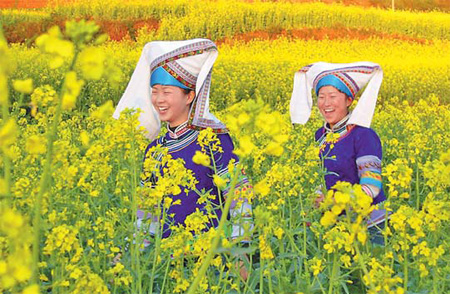
Two Bouyei women wander through the fields. [Photo: Hu Liangfu / for China Daily] The stream of tourists into the county over the past decade has brought transformation to the previously impoverished county. "About a decade ago, some farmers were too poor to feed themselves," Liu says. The tourism boom provided more job opportunities. Local farmers started small businesses, such as family hotels or ethnic handicraft production and retail. "They don't need to worry about food and clothes anymore. Some built their own houses and bought tractors," Liu explains. Rapeseed not only gives oomph to the local tourism industry's expansion but also is the most important local crop. The flowers grow throughout the country but are harvested at different times of the year, depending on local conditions. Luoping's rapeseed farmlands are among China's vastest. Cooking oil can be extracted after the flowers wither, which provides another income source for Luoping's farmers. Jin Xiaoqi, a 31-year-old farmer in Xiaogeda village, owns 1.2 hectares of rapeseed fields and earns nearly 9,000 yuan ($1,369) a year from the crops. She also sells engraved bamboo to tourists for 8 yuan to 20 yuan apiece, depending on the size. This brings in another 1,000 yuan a month. Another way in which rapeseed flowers sweeten life in the county is by fostering honey production. |
|
| Author: Source: China Daily Editor: Wu Qiong |
|


