涓枃绠€浣?/a>銆€|銆€



| Slow times, slow food | |
http://english.dbw.cn銆€銆€
2010-12-15 10:58:40
|
|
|
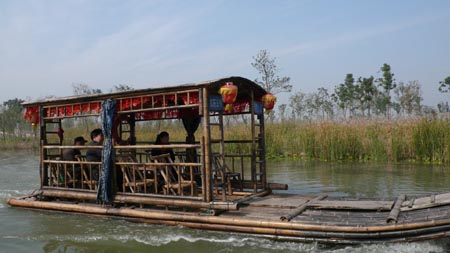
A wooden boat on Yangcheng Lake. Photo: Yue Hongyan
Hairy crabs from here are famous for their big size and fresh meat. They got their name from the clumps of hair-like fiber that grows on their undersides, their legs and around their pincers. Actually, I did have my doubts about how many real Yangcheng Lake crabs are actually served in China and how good they would really be, as it is such a popular dish and demand surely outweighs supply. With exports on the increase and a price of a pair of hairy crabs reaching as high as 250 yuan ($37) for 175 grams each, I was unsure that my meal would be authentic. My fears soon fell by the wayside when I saw and tasted my hairy crab in the restaurant. The meat was far more delicious that sea crab, the size was impressive and with a shining gold and red shell on my plate after steamed, the local delicacy lived up to its fame. There is a saying that the ninth month of the lunar calendar is best for eating female crabs and the 10th month is best for male crabs. The cream in the crab is especially tasty, delicate and just oily enough. With a splash of ginger vinegar and accompanied with huangjiu (fermented yellow wine), the taste of crab was perfectly enhanced. Eating a hairy crab takes some patience and if you rush, you may not taste the delicacy fully, for you need to split the whole palm-sized crustacean part by part. In Chinese history, people once used eight kinds of tools especially for this task. You can imagine the complexity of this cuisine, but the pleasure is also in the process. After enjoying two delicious crabs and my appetite more that satisfied, I completely understood why people can spend so much time and energy in eating this small, hairy crustacean.
|
|
| Author锛? Yue Hongyan 銆€銆€銆€Source锛? Global Times 銆€銆€銆€ Editor锛? Wu Qiong | |