涓枃绠€浣?/a>銆€|銆€



| Memento Mori: Chaodou Hutong | |||
http://english.dbw.cn銆€銆€
2010-12-14 10:51:57
|
|||
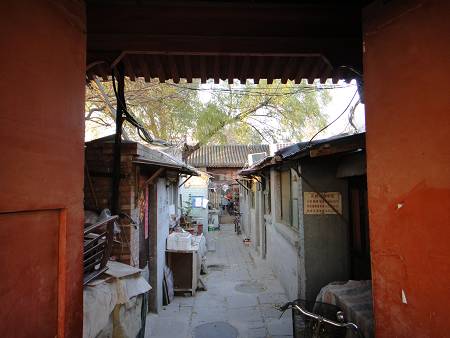
As the ancient capital of China for centuries, Beijing has not only been the home of emperors in the Ming and Qing dynasties but also that of nobles. The homes of these imperial bigwigs helped create the unique and exclusive architectural culture alongside the Forbidden City. If you access Nanluoguxiang from its south entrance, the Chaodou Hutong (literally "Fried Bean Lane" - it's hard to track where this name came from) is on your right. It's a convenient place to explore the former mansion of Prince Seng Ge Lin Qin (1811- 65). But be sure to do so discreetly; the residents who currently occupy it are understandably annoyed by the constant visitors. Born into Mongolian nobility and distantly related to Genghis Khan, Seng inherited his ancestor's heroic character by both defending his nation against the invasion of the foreign powers during the 1840s Opium War and oppressing the Taiping rebellion (1851-64), a revolutionary Peasant's Revolt assembled under leader Hong Xiuquan. Seng was ultimately unable to stop the United Army of Britain and France landing on Chinese soil in Dagukou, Tianjin in 1860. Withdrawing to Tongzhou, in the southern suburbs of Beijing, Seng decisively lost the battlefield, leaving the capital open to the foreign armies. Seng was suspended from duty until designated a commander for his troops to fight against the Taiping rebellion, which was bloodily quashed in 1864. This victory sustained him for some years until he was killed after a battlefield at the age of 55, ending his glorious life on horseback. The loss of this lynchpin of the Qing military further accelerated the collapse of the already-weakened feudal Dynasty, just half a century later. An official of prestigious social status and historical impact, Seng's home was by no means unfitting to his name. In fact, the No 73, 75 and 77 were all part of his residence here, although only No.77 is today noted by the government's Cultural Relic Unit as the former residential place of Prince Seng besides the door. Nevertheless, when I came, the situation seemed rather callous for its lack of maintenance over the decades. Thanks, then, to 70-year-old Wang Guimei, No.77's resident since the 1950s, who painted me a picture of the original look of the hutong when she first moved in. "There were four rows of houses on each side, in the front and back yard, full of imperial style," said Wang. "Their beautiful gardens with pavilions were just the part of the ordinary scenery here." The prince's house had about three entrances along the lane, she recalled. "No.77 was just the side door," she said. "His home stretched from Chaodou Hutong to Banchang Hutong in the north." But, as Wang later added, they now are separated into individual courtyards; no wonder there are notes about Prince Seng's houses on No. 30 and 34 in Banchang Hutong. |
|||
| Author锛? 銆€銆€銆€Source锛? Global Times 銆€銆€銆€ Editor锛? Wu Qiong | |||