涓枃绠€浣?/a>銆€|銆€



| Revolutionary Road | |
http://english.dbw.cn銆€銆€
2010-12-02 13:10:31
|
|
|
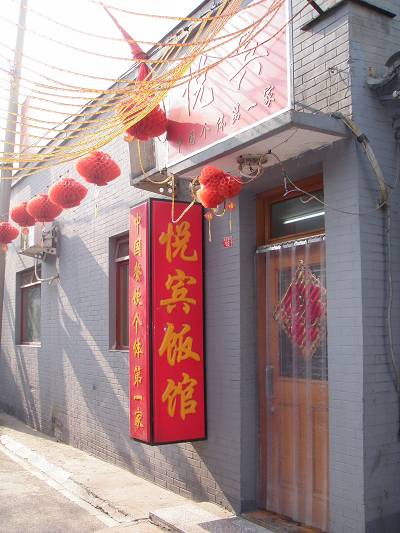
Neighboring the far more famous Dongchang Hutong - historical home to Li Yuanhong, president of the Republic of China over a number of nonconsecutive years in the early 20th century - Cuihua Hutong may be a bit less tra聬 cked, but by many measures holds an even greater wealth of fascinating stories. I knew in advance that this might be the former residence of Zhang Xun, the post-Qing-Dynasty warlord who attempted to restore feudalism to China, no evidence remains though. Beyond this historical blip, however, there are a number of other little treasures to discover about this small back alley. On the west side of the lane, there is a small restaurant called Yue Bin whose ordinary, unassuming fa莽ade belies the fact that it was the first privately-owned restaurant in China after the founding of the PRC in 1949. Ever since opening its doors in 1980, Yue Bin has enjoyed a great deal of media attention, though it is no longer a remarkable oddity now that Beijing is home to countless private eateries. Talking about their business, 77-year-old husband-and-wife-team Guo Peiji and Liu Guixian said that the passion they feel toward their enterprise hasn't diminished at all in the ensuing 30 years. "Before we opened the restaurant, there was not even a concept of this kind of thing, let alone a government policy to support it," Guo said. "My wife spent a long time rounding up the proper approvals." Since - like many Chinese at the time - they couldn't own their own residence, their communal dormitories were converted into the restaurant's kitchen and dining room. Short of cash, they managed to secure a 500-yuan loan from the bank to buy the kitchen wares including a secondhand fridge - but by the time the restaurant fi nally opened, they only had 36 yuan left to their name. Liu said that the biggest problems upon opening were regular and debilitating food shortages - a result of the ticketed rations system established at the time. Yet through various personal connections, Liu managed to secure a steady supply of all the ingredients she needed - enough for a few small family-style courses, which in Beijing at that time constituted a veritable extravaganza. Charging a mere one yuan for a big plate of duck, for example, Liu found that her creations were gobbled up practically faster than they could be served. "I remember the hutong was absolutely packed with people - some for their first-ever restaurant experience, others just to take a look at this novel creation," Guo said. |
|
| Author锛? 銆€銆€銆€Source锛? Global Times 銆€銆€銆€ Editor锛? Wu Qiong | |