涓枃绠€浣?/a>銆€|銆€



| 鈥淓nter Heilongjiang鈥?Series: Origin of nation, history and culture | |
http://english.dbw.cn銆€銆€
2010-12-01 10:25:33
|
|
|
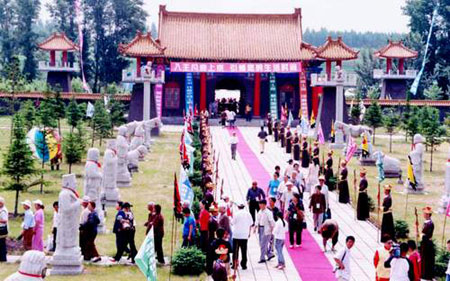 In 1616, Nurhachi, leader of Sushen lineage descendants of the Jurchen, rose and 400 years later after Jin perished the Post Jin Regime was founded. In 1636, Huang Taiji became the emperor and changed title of a reigning dynasty into Qing, called Manchu. 鈥淓rase trace of Jin descendants and unify Han nation and Mongolian鈥? which cleared obstacles for unification. The population of Jurchen was not big. It was less than one million before entering Guan. Thanks to political foresight of Huang Taiji, he was good at uniting different nations. The strength became stronger and stronger. In 1644 AD, Shizu entered Guan, made Beijing as the capital and gradually unified the whole nation. It handed down 10 generations and lasted 268 years. 鈥淜ang, Yong and Qian鈥?feudal spirit appeared in this period. According to records of historical books, the history of nations in Heilongjiang Valley had close contact with the culture of Central Plains. Archaeological discoveries of nations in Heilongjiang Valley also prove production and life of ethnic minorities in Heilongjiang enter into the civilization early. In history, nations in Heilongjiang Valley developed continuously and that causes Heilongjiang to be rich in the multi-ethnic and cultural reserves. |
|
| Author锛? 銆€銆€銆€Source锛? dbw.cn 銆€銆€銆€ Editor锛? Wu Qiong | |