涓枃绠€浣?/a>銆€|銆€



| Drawn to the movies | |
http://english.dbw.cn銆€銆€
2010-11-30 10:05:29
|
|
|
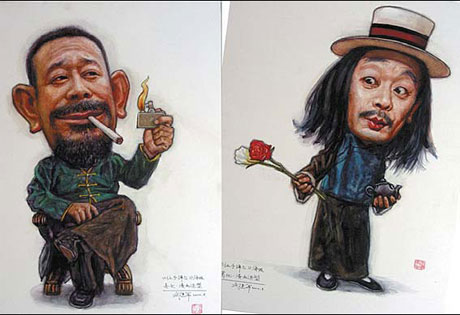
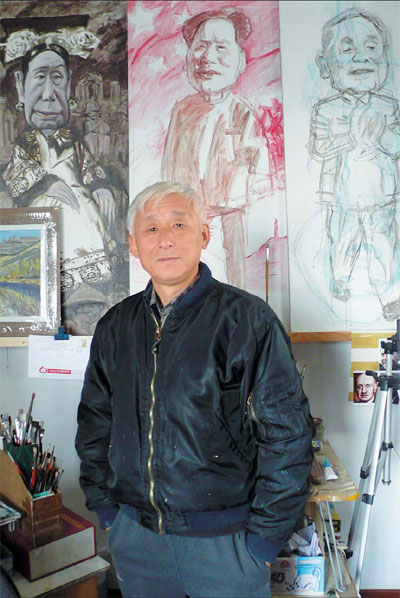 A film poster painter until the early 1990s, Wu Jianjun says,"I loved that job." [Photos by Zhang Tao / China Daily]
As recently as the 1990s, Chinese film posters were hand-painted conversation pieces that enticed audiences into the theaters. Chen Yingying and Wen Chihua from China Features report Beijing lift operator Zhang Yueqing took a break from her job every night for a week so she could see a recent exhibition of vintage hand-painted China-related film posters called Movie China Art. "They remind you of the movies you watched and the times they were set in," says the 40-year-old migrant worker from northeastern Heilongjiang province. Zhang was a big movie fan in the 1980s when she still lived in remote Fenpin village. "A film projection team, usually comprising two persons, would regularly come to show a movie in the open air in our village," she says. "They carried the projector on a donkey cart." When the movie was over, Zhang and her friends would follow the projectionist, walking miles to other villages to watch the film again and again. She has not seen any movies since coming to Beijing in 2003. "I would lose interest in going to the movie after seeing the film's posters," she says. "Computer-designed, glossy posters for films like the blockbuster Hero directed by Zhang Yimou make me feel the films of today are too removed from my life. So I don't bother to go to the cinemas." Indeed, compared to printed posters, hand-painted ones are "simple, pure and humane. They attract audiences to see the movies", says Cui Yongyuan, host of the Movie Stories series of CCTV. Cui, 47, recalls that, when he was a little boy, he wanted to be a film poster painter. "At that time, almost every Chinese was a movie fan and painting posters was an enviable job because the painters got to see lots of movies for free." In fact, before the 1990s, when computers made poster-making easier and faster, almost all film posters in China were hand-painted by artists who worked for the local movie theater. The first hand-painted Chinese film posters, in the 1920s, about 20 years after the first Chinese film Dingjun Mountain was made, appeared on billboards. "A typical poster carried a close-up of the heroine, against a blurred background," recalls Xiao Ge, a former poster painter in Chongqing. As for the colors, she says, "bright orange and red were often used, whereas black and white were taboo. And, of course, anything that might suggest violence, such as blood and killing, was forbidden". Film poster painting is different from oil painting and poster art. "It requires a more sentimental involvement with the film. You need to live with the characters in the film you paint for, weeping and laughing with them," she says. The 1980s witnessed a boom in hand-painted movie posters. This was a period of artistic renaissance for most Chinese, who had just gone through the decade-long chaotic "cultural revolution" (1966-76). The government lifted the ban on 376 old Chinese films, which had been denounced as feudalistic, capitalistic and revisionist works during the "cultural revolution" and poster artists found themselves with a lot of work. While these painters had some artistic talent, most had no formal education in art. The poster painter would also double as usher or ticket seller when required. Wu Jianjun, 60, was working as a machinist in the Beijing Machine Factory when hired to paint film posters in 1980. The factory's auditorium became the theater. "I loved that job. We were valued by the film companies and appreciated by audiences," he says. "Back then, hand-painted film posters were the only way to advertise films." Talking with pride about his work, he says, "We were unknown to the audience, but my works were enjoyed by many people. People would stop by my posters and talk about the films. A good poster could bring in more people to watch the film." Wu's works included posters for Chinese movies such as Blessings and My Memories of Old Beijing, and for foreign ones such as Duccio Tessari's Zorro and Roman Polanski's Tess. These films were very popular in the 1980s. "Painters preferred doing posters for foreign films because they were more interesting and Western faces easily stood out on the poster." Film poster painters from different cinemas in Beijing would see previews of films once a month. "I would design the poster based on my understanding of the film," Wu says. During the "cultural revolution", film poster painters could not do as they wished. Most of them painted the backgrounds in red, to be politically correct, and portrayed characters wearing stiff expressions. At first, Wu used charcoal pencils to outline the images. When his skills got better, he painted directly with an opaque watercolor known as poster paint. "I could finish a poster in one or two days after seeing the film," he says. He could produce as many as four broadside posters and some smaller ones each month. Posters for any given film would vary from city to city, as they were painted by different artists. "We would also participate in the national film poster painting competition to learn from each other," says Wu, who visited most parts of the country during the annual National Film Poster Group Exhibition from 1982 to 1992. Nowadays, high-tech theaters have replaced the old traditional movie houses. But even as poster painters are becoming a thing of the past, hand-painted posters have not been entirely forgotten. Julian Fisher, a British film poster collector, organized the Movie Art China exhibition of film posters in October in Beijing. More than 300 hand-painted film posters were displayed. He notes that "many people enjoy the posters because they have seen the movies and the posters remind them of the times they used to live in". Unlike printed movie posters, "hand-painted posters reflect the mood of the movies", Fisher says. "Each is a work of art." |
|
| Author锛? 銆€銆€銆€Source锛? China Daily 銆€銆€銆€ Editor锛? Wu Qiong | |