涓枃绠€浣?/a>銆€|銆€



| A tale of three cities - Harbin, Changchun and Shenyang | |||
http://english.dbw.cn銆€銆€
2010-11-26 09:49:05
|
|||
|
Steeped in history and heavily shaped by foreign influences, the cities of Harbin, Shenyang and Changchun illustrate the eclectic blend of old and new, East and West, in northeast China.
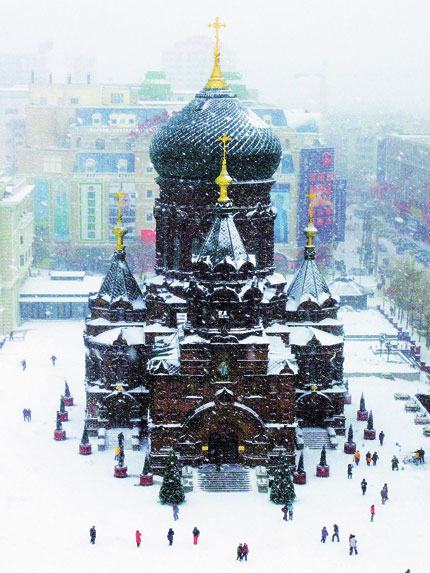
Harbin The capital of Heilongjiang Province is a romantic city infused with exotic flavors. At the start of the 20th century, Westerners referred to Harbin as the "Oriental Moscow" and the "Little Paris of the Far East." It is not difficult to understand the origins of such a mixed culture: foreigners driven from their countries by war built Harbin in the style of their homeland. Harbin is a city that has changed hands many times. The native home of the Sushen and Jurchen people, it later became the birthplace of two dynasties: the Jin (1115-1234) and the Qing (1644-1911). For thousands of years the city was home to more than 30 ethnic minorities such as the Manchu, Daur, Oroqen, Xibe and Ewenki. However, it was mainly the massive influx of foreigners in the last 100 years that has given Harbin its eclectic character. Architectural showcase When I was very young, my entire family took an old-fashioned train to Harbin. Our first encounter with the city was at the old Harbin Train Station, which was replaced by a European-style building a few years later. People today still refer to the old train station as the "old station" and "old ticketing house." Since its completion in 1904, the old train station was more than just a gateway to this city; the landmark also marked the place where the Russian "Art Nouveau" style of architecture gained its foothold in Harbin. The old Harbin Train Station was built in the Romantic style - a rare sight in China. But not in Harbin. Other Romantic-style buildings include the Harbin Railway Hospital built in 1900, the Moscow Shopping Mall built in 1906, the Commercial School House, the Telephone Bureau, the Governor's Office, the Saint Nicholas Cathedral built in 1898, the Church of the Annunciation at Nangang Central Square, the Alekseyev Church and the Saint Sophia Cathedral. These are all the legacy of the Art Nouveau movement. The pedestrian-only Central Avenue is an "architectural museum" with an impressive mix of building styles. This is where one can find the Russian-style Huamei Restaurant, the French-style Modern Hotel, and the Baroque-inspired Education Bookstore and Jiangyan Primary School. At the turn of the 20th century, the city was a meeting place for expatriates from more than 20 countries. A dozen countries had set up consulates here, and Harbin was also dubbed "a city of flags" for the many flags that fluttered high above the city. The Central Avenue developed in 1898 is the epitome of Harbin's contemporary history. Back then, the people living on this street were mostly Chinese, and so when city authorities wanted to consolidate the Chinese population from places scattered around the city into one area, Central Avenue emerged as an obvious choice. It became the Chinese quarter of the city and was renamed Chinese Avenue in 1900. The same policy was also applied to other nationalities, as evident in these designated residences: Mongolia (Xiqidao) Street, Balkan (Bashan) Street, Belgium (Bile) Street, Romania (Lujia) Street, Warsaw (Anping) Street, Cossack (Gaoyi) Street and Korea (Xibadao) Street. Shrewd foreign settlers were quick to realize that the street was prime real estate and many rushed to buy land and erect buildings on Chinese Avenue. Soon the "Chinese" name was strongly opposed by the foreigners who had invested and set up shop, and so in July 1928 the street was renamed Central Avenue. Many European-style buildings line Central Avenue. Every evening, folk musicians and singers perform by the colorful lights of Central Avenue. This has been the custom for a hundred years. During World War II, the foreign artists in Harbin organized and performed countless classical songs and musicals - this cultivated generations of singers, conductors, composers and musicians. Almost all Harbin residents grew up surrounded by the sound of music. Today the famous Harbin Summer Music Festival has become a mainstay in this city. This is indeed a city of melody. |
|||
| Author锛? 銆€銆€銆€Source锛? Shanghai Daily 銆€銆€銆€ Editor锛? Wu Qiong | |||