涓枃绠€浣?/a>銆€|銆€



| Talent has the volume turned down | |||
http://english.dbw.cn銆€銆€
2010-11-18 14:06:56
|
|||
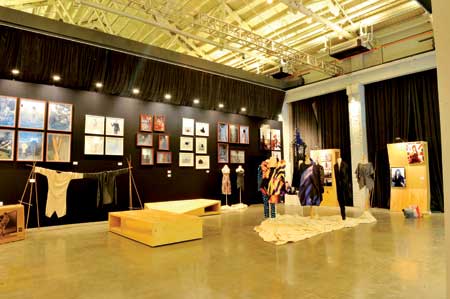
Get It Louder considers itself "China's most influential and closely watched exhibition of emerging, young talents across creative disciplines." Setting up camp at 800Show on Changde Road, this is the third installment of the show, which features an extensive collection of art, as well as exciting video screenings and discussions. The exhibition theme has been constructed around the concepts of interactivity and networking that are at the heart of Web 2.0 developments on the Internet. While impressive in its scope, the exhibition is something of a letdown, with a range of problems. The show's confused curatorial approach is evident immediately on entry to the main building. Housing far too many artworks, this space includes some truly eccentric pieces that seem to have no place in a contemporary art show. The two most unappealing works, both part of a series by Alice Wang, are essentially school science projects. In one, which for some reason takes the bladder as its focus, 77 containers have been filled with a blue liquid that presumably represents urine. Each is placed on top of a medical questionnaire with answers that have been filled out by participants, while posters on the wall give very basic information about how the bladder works with accompanying diagrams. Even more pointless is the neighboring piece, which asks such profound questions as "How much can one pencil write?" or "Which language uses the most lead?" The artist has created several devices to apply a "scientific method" to work out the answers, five of which are hung on the wall. Although there are worthier pieces in the central section, including three impressive installations by Chen Zhou, which extend parts of pieces of furniture using long pieces of black cloth (exploring notions of virtuality and perception), the space is pervaded by curatorial problems. First, the space contains too many works, causing both sound and visual problems. Jiang Pengyi's photographs, nicely manipulated scenes of urban regeneration and decay, find themselves sharing a space with many other works, including a blaring video by Lei Ray and Lei Jiao and some simplistic designer lamps by the Rich Brilliant Willing collective from New York. Mats Bj?rk's sound-art piece consists of CD boxes fitted with solar panels, a device for reproducing a sample and a headphone input. The accompanying text talks about how varying levels of sunlight produce different quantities and qualities of sound in the headphones, including one poetic but misguided reference to how the music will change as the sun travels through the sky. Unluckily for the artist, the dim corner of the exhibition hall given over to the work offers only just enough light to make the unit produce a faint rasping sound. More problems More problems await visitors in Room 4, where two music-related pieces, including a very self-serving and quickly constructed installation by Ai Weiwei and Zuoxiao Zuzhou, are placed directly next to each other, essentially drowning each other out. The great man of Chinese art (Ai Weiwei) seems to be cropping up only in portrait form in Shanghai these days, this time smiling his Buddha-like smile in a series of photographs that serve as a backdrop to an amalgamation of different rock music. |
|||
| Author锛? Nick Muzyczka 銆€銆€銆€Source锛? Global Times 銆€銆€銆€ Editor锛? Wu Qiong | |||