涓枃绠€浣?/a>銆€|銆€


| More bang for your buck | ||
http://english.dbw.cn銆€銆€
2010-06-17 15:12:51
|
||
|
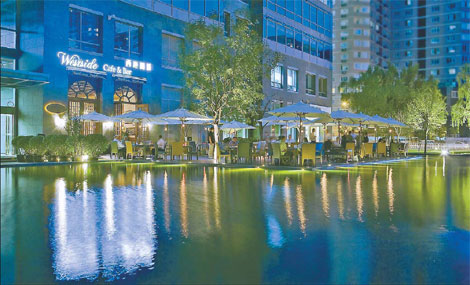
Gourmet Bang Street, sitting across from the Kerry Center, may be misleading in name. "Bang" is not what you think it means. It is the transliteration for "Countries" - the literary word so to speak. So, the name implies great cuisines from many countries. But "Bang" has a homonym in Chinese that means "great", which is very colloquial. My palate tells me that whatever part of the world the food comes from, it is truly and invariably "Bang". Spreading out on 8,000 square meters, one floor beneath the lobby of the Prosper Center Building, it is a clean and well-lit place with 10 restaurants for both casual diners and connoisseurs. Lunchtime attracts throngs of white-collar workers from nearby towers, so you'd better come in the evening if you want to take time and savor the epicurean delights. But don't let the unassuming decor fool you. Meticulous attention is given to every detail. It is the only eating place I know that hires a full-time art director whose job is to choose the background music for each venue. For example, the songs wafting out of its Court 5 Restaurant, with the old Shanghai architecture of Shikumen, are those by Zhou Xuan, the pretty songbird of 1930s Shanghai. Chinese cuisines are featured prominently, including two Hong Kong restaurants, the above-mentioned Shanghai restaurant, one with Huaiyang-style food and another with Shandong food. Repulse Bay presents traditional Cantonese dishes such as barbecued ribs, crab and home-style stir-fries. Causeway Bay is more of a snack joint that offers a rich array of congees, rice, noodles and dim sum. Yangzhou in Jiangsu province was one of the most vibrant cities in ancient China. Its influence radiated to every corner of the Yangtze River Delta. That's why one of China's four gastronomic styles is named after it. What looks like home-made dishes are prepared with so much loving care they are essentially turned into an art form. Try the meatball in a soup at Yangzhou Pavilion and you'll understand why it's never second-best at this place. Beyond the domestic flavor, Japanese cuisine is a highlight here, with a total of four restaurants. Each is devoted to teppenyaki, sushi, sashimi, izakaya, katei ryori and hotpot. The authentic Japanese hotpot comes with a variety of four soup bases: soy, salty, slightly spicy and mild, quite different from the Sichuan hotpot we are familiar with. |
||
| Author锛? 銆€銆€銆€Source锛? China Daily 銆€銆€銆€ Editor锛? Wu Qiong | ||