涓枃绠€浣?/a>銆€|銆€


| Excavation of ancient general's tomb throws up new mysteries | |||
http://english.dbw.cn銆€銆€
2010-06-13 14:16:42
|
|||
|
TOMB'S LAYOUT UNCOVERED
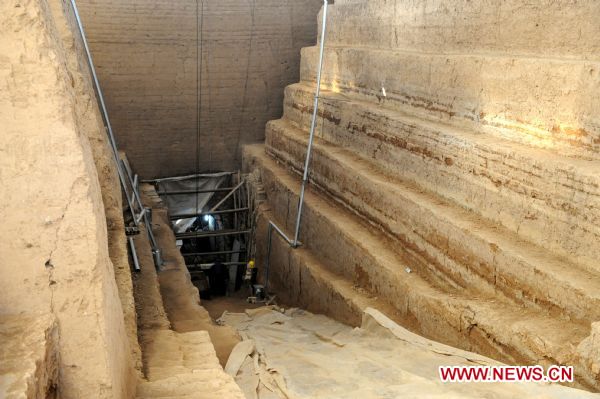
The excavation undertaken by the Chinese Academy of Cultural Heritage has uncovered the layout of the mausoleum. The square-shaped mausoleum comprises two pits covering 8,934 square meters. The No.2 pit has been identified as the coffin chamber of the tomb master, where a male skull, two female skulls and more than 250 relics have been unearthed. The male skull suggested the man was aged over 60, and the females were aged about 20 and 50, but archaeologists have not reached conclusions on their identities. Liu Shuguang, rector of the academy, said authorities were planning to build the mausoleum into a national archaeological relic park. THE EMPTY PIT Although the excavation of the mausoleum is almost complete, archaeologists are still puzzled by the purpose of the No.1 pit, which was found to contain only an iron sword. "The tomb was built at the same period as the main tomb, and the two are only 30 meters apart. The No. 1 pit is smaller and less decorated, which suggests it is a satellite tomb," said Pan Weibin, a chief researcher with the provincial bureau. He said the tomb had been severely damaged with seven holes opened by tomb robbers. There are many assumptions about the tomb. Some said it had been occupied by Cao Ang, eldest son of Cao Cao, who died before his father. Popular speculation has it the tomb might have stored Cao's weapons, or jewelry, or books. Liu Qingzhu, member of the Chinese Academy of Social Sciences (CASS), said the function of the satellite tomb was still a mystery, but it must have reflected Cao Cao's thoughts. He said experts have generally ruled out theories that the tomb had been occupied by Cao Cao's wife or one of his favorite concubines, as the tomb's standard suggested it was of a lower class. |
|||
| Author锛? 銆€銆€銆€Source锛? xinhua 銆€銆€銆€ Editor锛? Yang Fan | |||