|
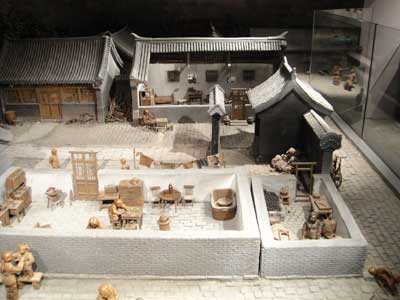
Hutong life in the 50s. [Photo:Global Times]
In need of an affordable afternoon keeping the kids occupied but can't bear to put them in front of the TV yet again? Stop by the recently opened national Museum of Women and Children, the first of its kind in China, located on the north side of East Chang'an Avenue, for a day of educational distractions.
In China, children and women's causes are often administered by the same institution, in this case, the All-China Women's Federation, which is the entity responsible for the new museum.
Back in October 2007, Zhang Shiping, general secretary of the federation at that time, explained the reason for the museum's construction in an article at www.china.com.cn. Zhang said that although China has about 2,300 museums, none are specifically dedicated to women and children. Yet in Chinese cultural history, the culture of women is a rich and indispensable part of the nation's history.
Thus Beijing received a curvy, modern structure containing a floor area of 35,000 square meters spread over six floors.
To create a diversified atmosphere and personalize the experience, the museum combines panel illustrations, relic displays, models, virtual reality images, digital videos, hands-on production and traditional games in exhibits that include more than 30,000 collections detailing the historical lives of China's women and children.
An emphasis on learning
Visitors entering the Children of Ancient China hall are first greeted by the intense scene of primitive children learning survival skills by following their parents as they chase prey in the mountains. Exhibits from centuries later detail feudal society's private education system, when talented boys were chosen to sit for imperial examinations according to the Han Dynasty (206BC - 220AD)'s selection system.
The scholarly can inspect rare, ancient editions of Chinese classics like The Analects of Confucius and The Great Learning, while the anthropologically minded can learn more about traditions like naming rituals and zhuazhoucezhi, wherein a one-year-old baby picks up articles that predict what the child will become as an adult. Vivid miniatures explain moral education, such as the story of Mencius' mother, who moved three times to find the best place to educate her son.
"Moral education is very important for children. Currently, material conditions for children's education have been greatly improved, but many parents ignore moral education. For example, many children don't follow traditions of basic filial piety toward their parents," remarked Zhao Changlin, a research fellow in a science research center who quite enjoyed visiting this section of the museum. "It is very necessary for children to learn those ancient moral stories," Zhao said.
The most persistent theme in the hall dedicated to the children of modern China is patriotism, including the organizations, activities and heroic deeds of children during tumultuous times. Uniforms, pistols, and red-tasseled spears used by the Anti-Japanese Children's Group during the 1930s and 40s are on display, as are many pictures of children, who were rarely photographed during that period.
|
 涓枃绠€浣?/a>銆€|銆€


