Modern forms
Wushu
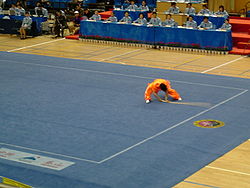
Modern forms are used in the sport wushu, as seen in this staff routine
As forms have grown in complexity and quantity over the years, and many forms alone could be practiced for a lifetime, modern styles of Chinese martial arts have developed that concentrate solely on forms, and do not practice application at all. These styles are primarily aimed at exhibition and competition, and often include more acrobatic jumps and movements added for enhanced visual effect compared to the traditional styles. Those who generally prefer to practice traditional styles, focused less on exhibition, are often referred to as traditionalists. Many traditionalists consider the evolution of today's Chinese martial arts as undesirable, saying that much of its original value is lost, and refer to the newer styles as "flowery fists and embroidered kicks".
Controversy of modern form work
Even though forms in Chinese martial arts are intended to depict realistic martial techniques, the movements are not always identical to how techniques would be applied in combat. Many forms have been elaborated upon, on the one hand to provide better combat preparedness, and on the other hand to look more aesthetically pleasing. One manifestation of this tendency toward elaboration which goes beyond combat application is the use of lower stances and higher, stretching kicks. These two maneuvers are unrealistic in combat and are utilized in forms for exercise purposes.Many modern schools have replaced practical defense or offense movements with acrobatic feats that are more spectacular to watch, thereby gaining favor during exhibitions and competitions. This has led to criticisms by traditionalists for endorsing the more acrobatic, show-oriented Wushu competition.Even though appearance has always been important in many traditional forms as well, all patterns exist for their combat functionality. Historically forms were often performed for entertainment purposes long before the advent of modern Wushu as practitioners have looked for supplementary income by performing on the streets or in theaters. Forms designed solely for demonstration first appeared during the Yuan dynasty.
Many traditional Chinese martial artists, as well as practitioners of modern sport combat, have become critical of the perception that forms work is more relevant to the art than sparring and drill application, while most continue to see traditional forms practice within the traditional context鈥攁s vital to both proper combat execution, the Shaolin aesthetic as art form, as well as upholding the meditative function of the physical artform.
Another reason why techniques often appear different in forms when contrasted with sparring application is thought by some to come from the concealment of the actual functions of the techniques from outsiders.[53]
|


