|
The World Media Summit (WMS) in Beijing is a perfectly-timed event that shows the "vision" of its organizers, and showcases China's growth in the past 60 years and increasing level of opening-up, Associated Press President and CEO Thomas Curley has said.
"The timing of the world media summit in Beijing is probably as perfect as it can be. There are a number of revolutionary changes that are working their way through the system right now, especially during the world economic crisis," said Curley in a recent interview with Xinhua.
 |
|
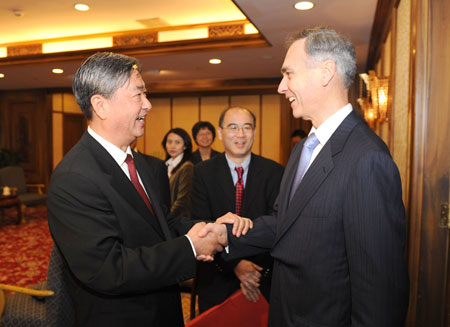
Li Congjun (L), president of China's Xinhua News Agency, meets with Associated Press (AP) President and CEO Thomas Curley in Beijing, capital of China, on Oct. 8, 2009. Thomas Curley was in Beijing to attend the World Media Summit, to be held on Oct. 8-10. (Xinhua/Ma Zhancheng)
|
The three-day summit from Oct. 8 to 10 has drawn top media organizations across the world, including print media, wire services, broadcasters and Internet companies, with the theme of "cooperation, action, win-win and development." Xinhua News Agency is playing host to the event, with eight other global media giants including AP as co-sponsors.
"I am grateful for (Xinhua) President Li (Congjun)'s vision in having us all come together at one time to consider what things we might do together," said Curley.
NATURAL OUTGROWTH
Talking about Xinhua's hosting of the WMS, Curley, who has visited China four or five times since 2003, including during last year鈥檚 Beijing Olympic Games, said he believes this is just a "natural outgrowth" of China's rapid development and continuous opening-up to the outside world.
"If you look at how much China has grown in 60 years, I think that says it all," said the 60-year-old veteran journalist, who began his reporting career at the age of 15. "China has grown big and sophisticated, so it is not surprising that China could host anew media conference."
"It seems to be also a natural outgrowth of the Olympics and China opening itself up, which it did around the Olympics, especially when it came to media," Curley noted. "I thought that was a very impressive effort the Chinese made around the Olympics and as you know we were granted special freedoms then. And so this seems to be a natural outgrowth of that."
"And I can tell you that we all appreciate not only those gestures, but the continuing extension of that type of thinking. Those ideas resonate well with all of us," he added.
The AP president also took notice of the fast expansion of Chinese media organizations including Xinhua over the recent years: "Xinhua has expanded in some important ways ... They have certainly expanded into more broadcast ... but also into a larger and deeper financial content area. So I think this conference is a natural outgrowth of its evolution."
CHALLENGES FOR TRADITIONAL MEDIA
During the hour-long interview in a 16th-floor office at the AP headquarters in New York City, Curley pointed out that the WMS is being convened at a time when traditional media organizations including the 161-year-old AP face three major challenges.
The biggest challenge is that traditional consumers, such as the readers and viewers, are now able to publish or produce their own material.
"They don't have to wait for people such as ourselves to provide them with contents to respond to. So the former customers are becoming themselves producers or journalists," said Curley.
The second big challenge for traditional media is to keep control of their content in this era.
"There are a number of free riders, there are a number of people who think that they have access to your content even though they did not take any of the risk or do any great amount of work to report the stories themselves," said Curley. "So keeping control of the content in this era and then still engaging with the new consumers is a balancing act."
And the third big challenge is to figure out how to get paid in this era, which he said "has been today the most elusive to all media leaders."
For years, AP has been trying hard to make major news websites and search engines pay for the AP content they use. "We were successful for a period of time, but in the last year the pirates have gained a lot of ground on us," conceded Curley.
"So we are at a position now of changing our rules and we have some gaps in our licensing policies that we have to close," he said, adding that it is equally important to "imagine a different set of products" for different customers.
"By 2011 we will have a multiple tier of products. We think that will be helpful too in both protecting our content and helping us get paid," he said.
"And as Xinhua and the rest of us look at the years ahead, we all have to be humble about what's out there," said Curley, who had led USA Today to grow into the largest-selling daily newspaper in the United States before taking over the helm at AP in 2003.
"Any incumbent organization, any older organization can lose its share or lose its way, so it's good to bring people together and talk about how people can cooperate and how these organizations can work," he stressed.
ERA OF NEW MEDIA
According to the AP president, the world has now entered a "new era of the new media," which not only has brought about challenges, but opportunities as well.
He pointed out that in this new era, more people are accessing news content more often than ever before from more places than ever before.
"We just got a report ... that in all the mobile applications that are out there -- all the opportunities to use mobile products in a different way -- the number one application is news," said Curley. "So that's an indication of the opportunity ... For us it's about engaging these new markets."
He explained in detail a recent experiment AP conducted during the U.S. Congress hearings on the appointment of a new Supreme Court Justice, Sonia Sotomayor: "We worked with Twitter to promote the content ... And then we did a blog ... to provide insight, some context to what was going on."
"That approach to the story telling generated three times the traffic that the regular AP story generated. So that's another indication that if we embrace these new media opportunities, we will be able to get larger audiences," he said.
"So one of the things we are doing at AP is changing how we report the news, how we release the stories," said the president. "So much change, much excitement, and still much to learn."
Claiming that AP has spent more than 60 million U.S. dollars on technology over the years, Curley said this world leading news organization is excited about and prepared for new business possibilities.
"We believe that there are some opportunities to improve our finances. And we have identified several of them and we intend to get more aggressive about trying to raise revenues through these new media opportunities," he said.
He also expressed confidence that the value of content, currently "at its lowest level," is about to rise over the next couple of years. "And so we want to be able to get our share," he stated.
PROPOSALS AND EXPECTATIONS
Curley revealed that at the Beijing summit, AP will put forward two proposals -- one is an explanation of its Sotomayor blogging experiment, and the other is an explanation of its news registry, which is a content protection effort.
"The topic that interests me the most is the one around engaging the new news consumers," he said. "It's about how to reach out to the news consumers using the new media techniques. That really has to be our concern."
"We know that people want the news, we just can't keep the news from them. It's in everybody's best interest if we figure out how to work it out. But we also want to get paid," he said.
The president went on to say that AP has also seen great opportunities in China's emerging new media market.
"This is an important moment. And there are so many emerging areas of content, as you know there are Internet portal companies in China and providers of content in sports areas, in entertainment areas that are doing pretty well and seemingly having some large revenues coming in their way," he noted.
AP hopes to work together with Xinhua and other Chinese media organizations to seize the opportunities and achieve common development, he said.
|


