|
Abolishing theocracy, separating religion from state, and protecting religious freedom
After the Democratic Reform was carried out in Tibet, citizens' freedom of religious belief, and patriotic and law-abiding monasteries were protected by the law.
Citizens have the freedom to become a monk or nun and monks and nuns can choose to live a secular life. Regular religious activities, as well as historical monasteries and cultural relics, were all protected.
The government adopted a policy of "political unity, freedom of religious belief and separation of politics and religion" to ensure that all religious beliefs were politically equal.
 |
|
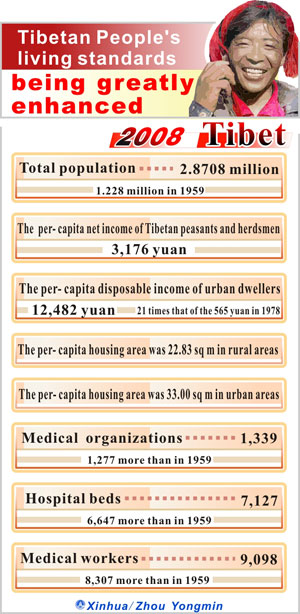
Graphics shows the figure of the Tibetan people's living standards, quoting a white paper titled "Fifty Years of Democratic Reform in Tibet" issued by the Information Office of the State Council, or China's cabinet on March 2, 2009. (Xinhua Photo)
|
The policy abolished monasteries' feudal privileges in economy and politics, repealed monasteries' feudal occupation and exploitation, and personal slavery, as well as feudal management and hierarchy inside the monasteries.
Public funds and properties inside the monasteries were managed democratically, serving as production funds and for supporting monks and nuns as well as regular religious activities.
The policy also allowed the monasteries' management committees to uniformly distribute land to monks and nuns in accordance with their labor ability, and managed production.
When the income of a monastery was unable to cover its regular expenses, the government would grant a subsidy, according to the paper.
Establishing the people's democratic state power, ensuring the people enjoy rights as their own masters
After the abolishment of the system of feudal serfdom, the emancipated people of various ethnic groups in Tibet established democratic organs of state power.
By the end of 1960, Tibet had established 1,009 organs of state power at township level, 283 at district level, 78 at county level(including county-level districts) and eight at the prefecture (city) level.
The number of cadres of Tibetan and other ethnic groups totaled more than 10,000.
Among them, Tibetans head all townships and account for more than 90 percent of the district-level leaders.
More than 300 Tibetan cadres held leading posts at or above the county level. And more than 4,400 liberated serfs and slaves were trained as cadres at the grass-roots level.
Former serfs and slaves were able to enjoy the same rights as their masters had by attending a general election in 1961.
In September 1965, the First People's Congress of Tibet convened, at which the founding of the Tibet Autonomous Region was officially proclaimed.
More than 80 percent of the 301 deputies to the congress were Tibetans or other ethnic minorities. More than 11 percent were patriots from the upper strata and religious figures in Tibet. Most of the deputies of the Tibetan ethnic group to the congress were liberated serfs and slaves.
|


